
Staff Blog
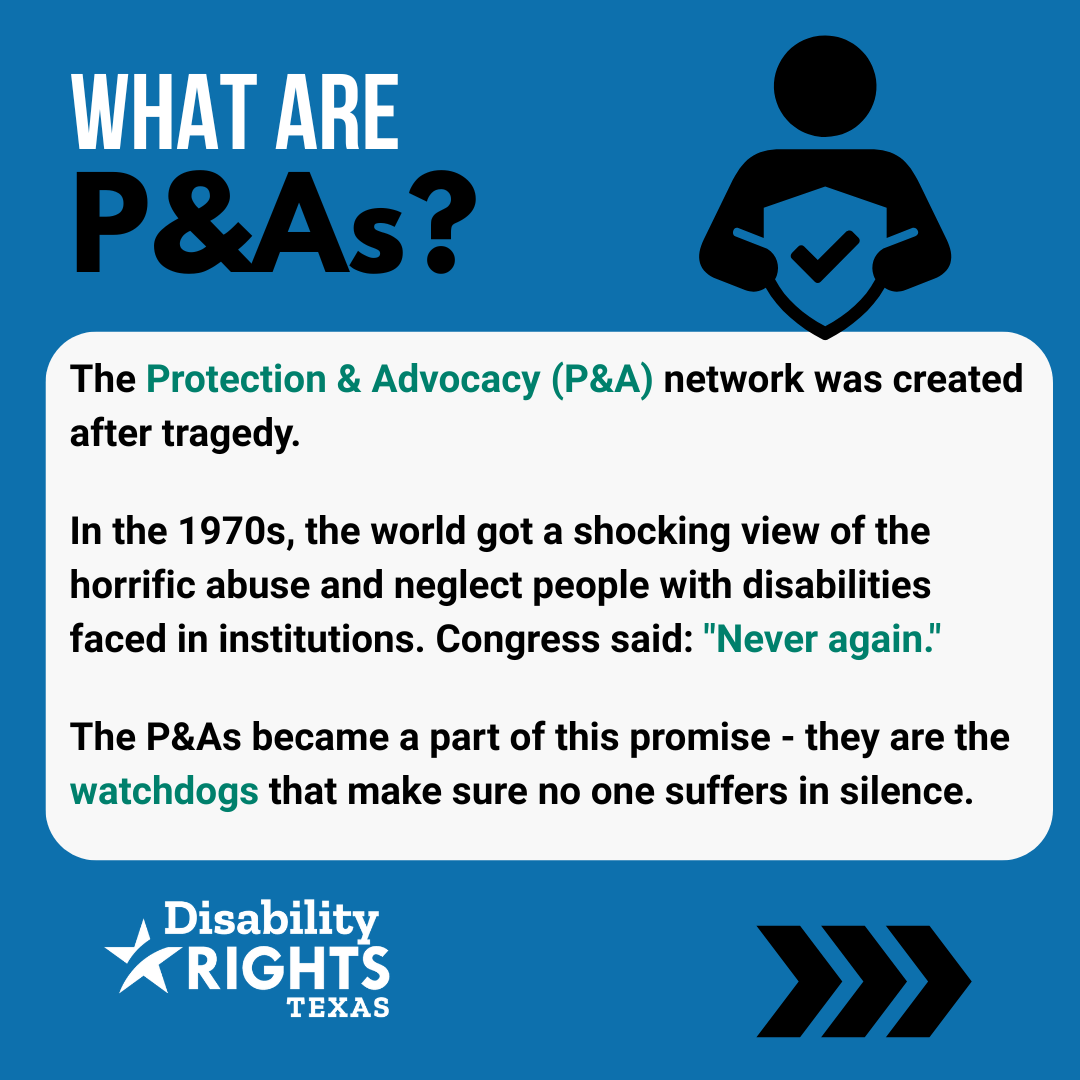
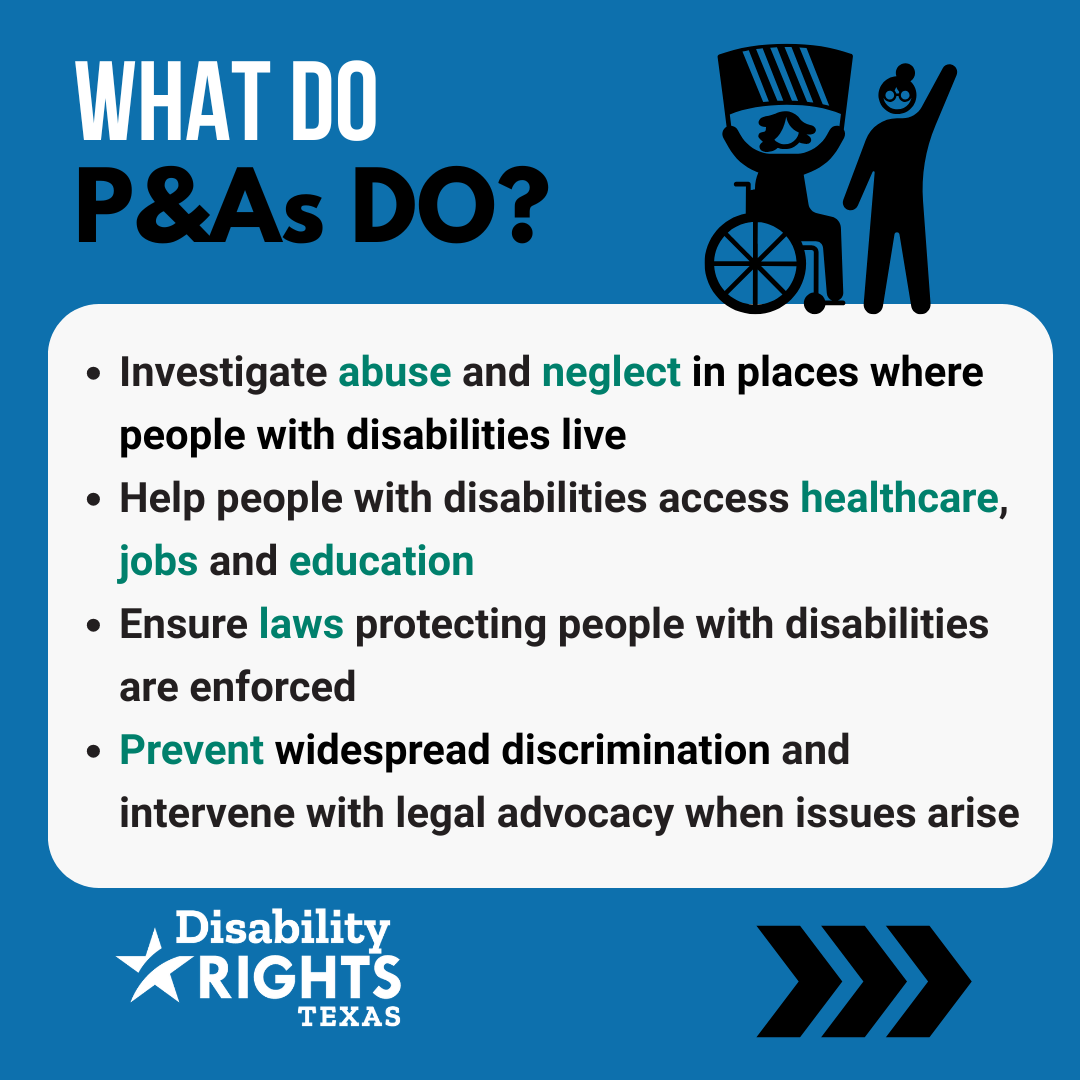
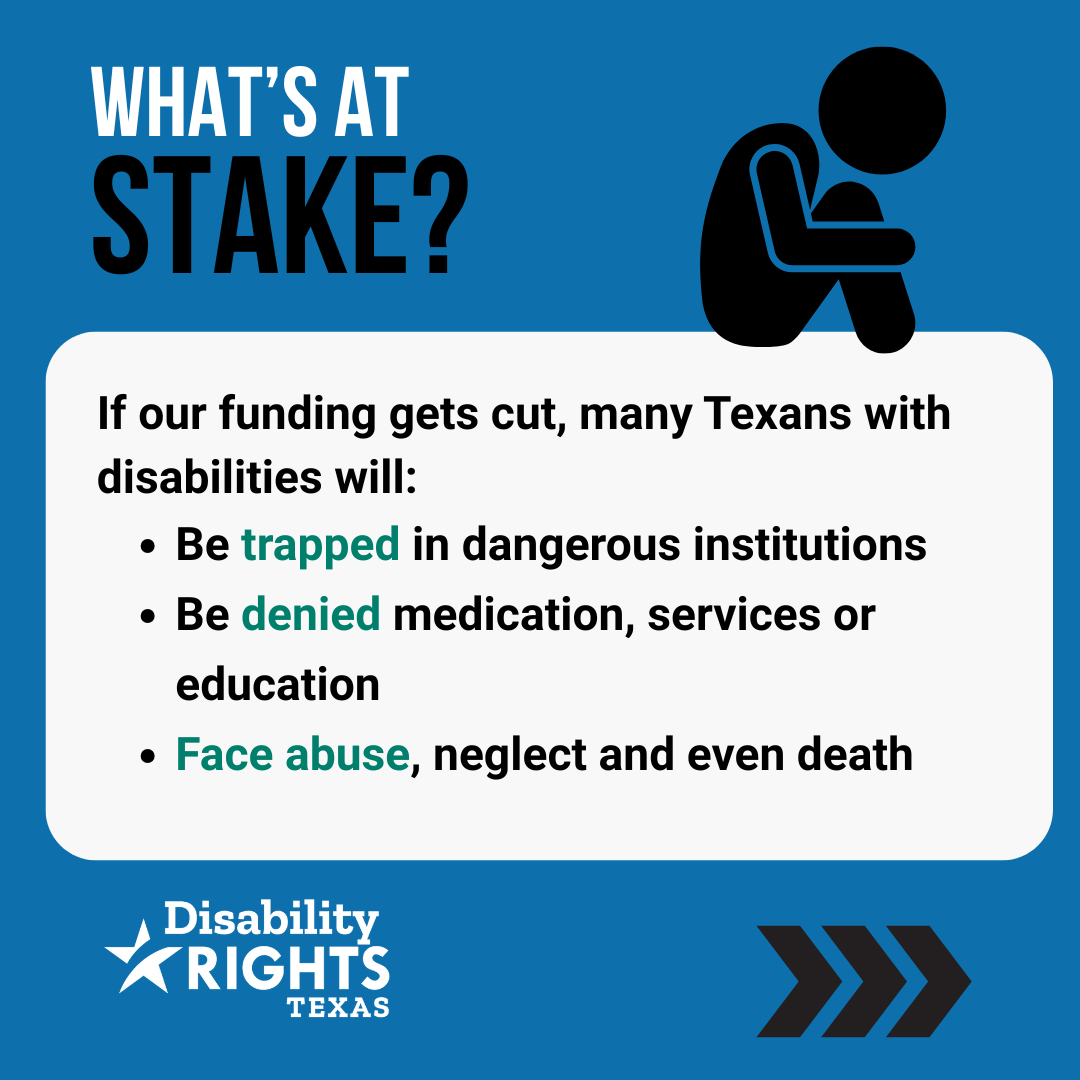
As many of you know, DRTx has recently experienced reduced funding and was forced to lay off staff and reduce services. And now, federal funding for all protection and advocacy (P&A) agencies like ours is on the chopping block for the coming year.
The good news: The Senate Appropriations Committee has level funded P&A programs. This means they want us to get the same amount of money as last year. (But it doesn’t cover the growing demand for our services.)
The bad news: The budget still has to pass the House, and earlier drafts of the President’s budget called for big cuts to our programs. Also, a leaked budget from HHS earlier this year signaled major cuts and complete elimination of some of our top federal grants.
The bottom line: The level of services and the number of people we can help may be changing drastically.
You can help: If we have helped you in any way in the past, whether through one of our resources, a training event, or case services, we’re asking you to consider helping us in one of the following ways:
- Share our Facebook post with the above message.
- Share with us how we’ve helped you so we can share it with others.
- Donate if you can. Any amount helps.
- Raise money for us by creating a Facebook fundraiser. Here’s how. If you are on your cell phone, open your Facebook app, go to our Facebook page, click on About and scroll down until you see Fundraisers. Then click on the 3 dots and select “Raise money.” From your desktop, go to our Facebook fundraiser page and click on the “Raise money” button.
- Follow the National Disability Rights Network on Facebook or Instagram to get more details about what is going on at the national level with P&As.
We are extremely grateful for all of the support you have given us over our nearly 50 years of doing this important work. Thank you for your unwavering commitment to us.














Staff Blog

School is back in session in Texas and this blog post highlights three key pieces of legislation passed in the 2025 Texas Legislative Session that impact students with disabilities.
To learn about other laws passed that could affect your child, attend our free 2025 Back to School Webinar at 12 p.m. Central Time on Wednesday, September 10 (register for the webinar).
Education Savings Accounts (School Vouchers)
The new Texas Education Savings Account (ESA) program, created by Senate Bill 2, will launch for the 2026–2027 school year. Here are some important things to know about ESAs:
- This law allots a higher level of funding – up to $30,000 annually – for students who would receive special education services if they were enrolled in public school. The amount is based on a student’s most recent IEP.
- SB 2 establishes a lottery system for selecting participants in the ESA program, with priority for low-income students with disabilities.
- Private schools are not required to provide special education services to students with disabilities, but they are subject to laws like the ADA or Section 504. (Private schools owned or controlled by a religious organization are not subject to the ADA.)
Please see our new Texas Education Savings Accounts resource for more details.
School Discipline
House Bill 6 made significant changes to the Texas Education Code school discipline laws including:
- Teachers may now remove a student for a single instance of interference, bullying, and behavior that is unruly, disruptive, or abusive.
- Students may now be placed in in-school suspension for an unlimited amount of time.
- Students below Grade 3 may now be placed in out-of-school suspension if their conduct threatens the immediate health and safety of other students or if there is documented conduct that results in repeated or significant disruption to the classroom.
See our new School Discipline Changes for 2025-26 resource for more details.
School Safety
Senate Bill 57 revised Texas Education Code school safety laws. Here are some highlights:
- Every school district must have a school safety and security committee. Previously, neither special education representation on the committee was required, nor attention to disability accommodations during safety drills and emergency situations was required.
- Every school district must have a multi-hazard emergency operations plan that outlines responsibilities and action steps in the event of an emergency. Previously, the plans only had to include a general description of steps to protect students with disabilities.
- Every school year, schools must conduct safety drills so students and staff have practiced how to evacuate and take shelter during an emergency. Previously, state law was silent about students with disabilities and how they should be accommodated during drills.
Our new School Safety 2025-26 resource provides more details.
Resources for a strong school year
Visit the Education Resources section of our website for additional resources to help you stay informed and advocate for your child.
Staff Blog

The Community Justice Worker (CJW) Program will create a Statewide model to systemically address the lack of or limited legal help available for low-income Texans. This Request for Proposals (RFP) seeks submissions from qualified vendors to develop, configure, and implement a robust, user-friendly Learning Management System (LMS). The LMS will:
- host training standalone modules (provided by a separate curriculum vendor that has already been selected),
- support certification and progress tracking, and
- ensure accessibility for learners statewide.
The selected LMS vendor will collaborate closely with the CJW Moonshot Team and the curriculum development vendor to deliver a seamless user experience.
This project will begin on October 1, 2025, and end on September 30, 2027. Proposals are due by 5 p.m. MST on Thursday, August 28, 2025.
Learn more about the CJW Program LMS RFP, including the timeline, minimum qualifications, and what information proposals are required to have.
The CJW Program is funded by the Texas Access to Justice Foundation.
Staff Blog
During the summer of 2025, a number of law school and undergraduate students interned at Disability Rights Texas. Thank you to all of the interns who were with us this summer. Learn more about some of the interns below.
Jerah Bevill

Jerah is a rising 2L at the University of Houston Law Center with a degree in Marketing from Prairie View A&M University. Currently a Law Clerk at Disability Rights Texas, she’s passionate about helping others with disabilities. As a new candidate for The Houston Journal of Health Law & Policy, Jerah is eager to learn about the relationship between the law and public health.
Gerardo Estrada
Gerardo is a rising junior at UT, majoring in Accounting and Integrated Master in Professional Accounting (iMPA). He really pays close attention to detail in financial matters, and he’s driven by a strong aptitude for forensic review and a commitment to uncovering critical information.
Temiloluwa Idowu

Temi is a rising 2L at Baylor Law School. She graduated from the University of Texas at Austin with a Bachelor of Arts in Economics and a minor in Accounting. Temi is passionate about public service and has interned for Texas Advocacy Project and a state civil district judge. This fall, Temi is looking forward to participating in a Baylor Law advocacy team and continuing to pursue legal advocacy.
During her clerkship with DRTx on the Housing and Transportation team, Temi worked on drafting reasonable accommodations and modifications, legal research of fair housing law, landlord-tenant matters, and analysis of cases for short-term advice. She secured a successful reasonable accommodation for a family who needed a search voucher after terminating their lease early for disability-related reasons. Temi clerked under the Fair Housing Clerkship Program at DRTx established by Madison Barney, who is sponsored by an anonymous donor from Equal Justice Works.
Cayli Lucia

Cayli is a rising 2L at the University of Houston Law Center. Her passion for disability advocacy was first sparked after feeling the impact of COVID-19 as both a teacher’s aide at a twice-exceptional school and as a disabled student herself. Cayli studied the intersection of political communication and K-12 education at the University of Texas, earning a Bachelor of Science in Communication and Leadership and a certificate in public policy.
Previously, Cayli interned with the Texas Council for Developmental Disabilities and the UT Austin Disability Cultural Center. This summer, she interned with the DRTx Education Team, advocating for students with disabilities statewide. Cayli envisions a career dedicated to disability advocacy and empathetic legal representation, centered on empowering clients and their families.
Maren Mihelich

Maren is a rising 2L at Baylor Law School. She attended Grand Canyon University for her undergraduate degree, with a major in Justice Studies. This upcoming fall, Maren looks forward to participating on a Baylor Law advocacy team and membership on Baylor Law Review. Her work experience as a caregiver has given her a passion for her clerkship at DRTx.
During her clerkship with DRTx on the Housing and Transportation team, Maren focused on drafting reasonable accommodations, legal research of fair housing law, client communication, and analysis of cases for short-term advice. She secured a successful reasonable accommodation for a client who needed to terminate her lease early for disability-related reasons. Maren clerked under the Fair Housing Clerkship Program at DRTx established by Madison Barney, who is sponsored by an anonymous donor from Equal Justice Works.
William Nguyen

William is a rising 2L at Vanderbilt University Law School. During his time in law school, William worked with Vanderbilt’s Medical Legal Partnership, a collaboration with the medical school’s Shade Tree Clinic to provide free medical and legal services to underserved communities in Nashville. He has also previously worked with incarcerated clients with disabilities as an intern with the Washington Lawyers’ Committee. William attended Georgetown University for his undergraduate studies, from where he holds a major in International Politics, and minors in Asian Studies and French & Francophone Studies.
William is personally connected with the work at DRTx as someone with a mental disability, and his background in policy and civil rights has further shaped his legal advocacy work.
Rachel Rosenberg
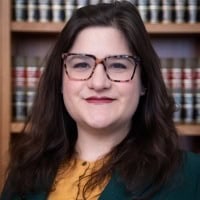
Rachel is a rising 2L at Baylor University School of Law. She attended the University of Florida for her undergraduate degree in Criminology with a minor in Family, Youth, and Community Sciences.
Previously, Rachel has worked with Americorps, City Year Miami, as a literacy learning interventionist, the Miami Dade Public Defender’s Office, at Clarke Silverglate, PA, a boutique commercial litigation firm, and Morgan & Morgan, a plaintiff’s personal injury firm. While interning at Disability Rights Texas, where she worked on housing, reasonable accommodations, and landlord-tenant matters. Rachel is also the Community Outreach Coordinator for Baylor Public Interest Law Society.
Her legal experience before law school informs her client-centered, compassionate approach to legal advocacy.
Annelane Sallee

Annelane is a rising 2L at the UT School of Law. She is from Brighton, Michigan and has a bachelor’s in communications from North Central University. Annelane has experience volunteering with foster care students and she’s interested in practicing law that involves working with children and people with disabilities. During the recent spring semester of 1L, Annelane did pro bono work with DRTx and Speak. She will also participate in the Children’s Rights Clinic at UT this upcoming fall. Annelane is looking forward to continuing her education and learning more about this practice of law.
Mason Smith

Mason is a rising 2L at the University of Texas (UT) School of Law and he’s looking forward to serving as VP of the Law Student Disability & Neurodivergent Alliance. His professional interests lie in exploring the nexus between disability and other areas of the law, such as housing, education, healthcare, and AI. As an individual with a disability himself, Mason hopes to one day combine his personal experiences with disability with his knowledge of the law to successfully advocate and advance the rights of individuals with disabilities across a variety of areas. He has thoroughly enjoyed the experiences he’s had at DRTx this summer, from monitoring federal trials to writing due process complaints and everything in between.
Amber White

Amber is a rising senior at UT, majoring in Sustainability Studies and minoring in Sociology. She is a fellow with the Youth Justice Alliance, who matched her with DRTx. Amber is excited to pursue a career in law with a focus on environmental and policy law. She will be continuing her undergraduate studies this fall with a study abroad sustainability program in Sydney, Australia.
Staff Blog

35 years ago, the following big events made the news:
- The first web server was created, starting what would later become the world wide web.
- The first McDonald’s opened in Moscow.
- “Cheers” was the top-rated TV show, and “Home Alone” was the biggest grossing movie.
- Anti-apartheid leader Nelson Mandela was released after 27 years in prison.
- AND…the Americans with Disabilities Act (ADA) was passed!
On July 26, 2025, our country will mark 35 years since we enacted this ground-breaking legislation. But – we all know that just because something is the law doesn’t mean it is upheld.
It takes the work of disability rights activists and watchdog groups like ours to ensure people with disabilities are treated humanely and fairly. To ensure that they able to participate in every part of the communities where we live. To ensure that they have access to the things that all people need and want such as healthcare, housing, jobs, education, and more.
We’re here to uphold the ADA and other disability rights laws so that people with disabilities never again face the widespread inhumane treatment and isolation they have faced in the past.
The passage of the ADA was a proud moment in our history, reminding us how our nation can be great – because a nation that is great values the life of every citizen, including those with disabilities.
To honor the ADA 35th anniversary, we invite you to watch the recently released PBS documentary, “Change, Not Charity: The Americans with Disabilities Act” that tells the emotional and dramatic story of the decades-long push for equality and accessibility that culminated in the passage of the law.
And take a few minutes to read about some of our most recent victories in upholding the ADA:
Staff Blog
Our 2024 Impact Report, “Paving the Way to a More Accessible Lone Star State,” is now out.
The report details how we protected the rights of thousands of Texans with disabilities and ensured equal access to things healthcare, employment, education, housing, and more. Learn about how many people’s lives we impacted, the strategies we used, and some of the inspiring success stories.
The 2024 Impact Report is available as a flipbook or as an accessible PDF.
Thank you to everyone who has supported us and helped us pave the way to a more accessible Texas.
Staff Blog

The Texas Hill Country experienced devastating flooding on July 4, 2025. To help Texans with disabilities and others recover from the disaster, we created the Texas Hill Country Flooding Event Resource page.
The resource page includes disaster recovery information about various topics and it will continue to be updated as new information becomes available. Some of the topics it covers include:
- Getting help from FEMA
- Disaster Recovery Centers
- Getting financial assistance from the Red Cross
- Applying for Disaster Unemployment Assistance
- Replacing durable medical equipment (DME) and assistive technology (AT)
- Reporting property damage
- Legal help available
- SNAP
The information on the resource page is subject to change, so check with the relevant government agency or organization to see what is available for you. State and local partners continue to encourage the public to call 2-1-1, visit the 211 website, and monitor local media outlets for alerts and information about resources.
Staff Blog
This article first appeared in the Texas Criminal Defense Lawyers Association’s “Voice for the Defense” (Volume 54, No. 5)
By Sarah Beebe
Did you know students can be disciplined by their school districts for their juvenile offense even if it didn’t happen at or near school? It’s true. The Texas Code of Criminal Procedure Section 15.27 requires law enforcement agencies to notify the school district the student was attending at the time of arrest of the charge within 24 hours. This notice constitutes a reasonable belief that the student has engaged in an offense punishable under Chapter 37 of the Texas Education Code, the discipline chapter.[1] Once school districts have a reasonable belief that a student has engaged in a punishable offense, they can discipline the student even if the charge is pending, or the youth has been placed on deferred adjudication or in a diversion program.[2]
In these circumstances, school districts typically propose to place students in the district’s disciplinary alternative education program (DAEP), or for very serious offenses, specifically Title 5 felonies and aggravated robberies, in the county’s juvenile justice alternative education program (JJAEP).[3] Before the school can place a student in an alternative education program, the student is entitled to certain due process rights.[4] Those rights include notice of the reason for the proposed discipline, the nature of the discipline, and information about the right to appeal.[5] Notice should be provided to the student’s parent the day the action is taken, but if the school administrator is not able to reach the parent that day, the administrator can mail written notice to the parent’s last known address.[6]
Once a parent receives notice of the proposed discipline, they have the right to participate in a conference with the school administrator.[7] This is an opportunity to present evidence of mitigating factors to the administrator in an effort to persuade them to forego the proposed discipline. In Texas, a school administrator should consider any mitigating factors presented, but must consider the following six factors whether the discipline is mandatory or discretionary:
- self‑defense, if relevant;
- intent or lack thereof;
- a disability that impairs the student’s ability to understand the wrongfulness of their behavior;
- the student’s disciplinary history;
- status within the foster care system; and/or
- status as a homeless student.[8]
Parents are often unaware of their right to have a conference with the school administrator so they skip this step, but this is a valuable opportunity to change the administrator’s mind and halt the disciplinary process so it’s critical that parents do not unintentionally waive their right to a conference.
If the school administrator decides to move forward with the proposed discipline, a parent usually has the right to appeal the decision to the school district’s superintendent or their designee.[9] If the parent disagrees with the decision made at the next level of review, they may be able to appeal the decision to the school board, or request a trial de novo by a county district court.[10] There are exceptions to the appealability of disciplinary placements for certain serious offenses, though, including Title 5 felonies and aggravated robbery.[11] The student will typically be required to remain in the disciplinary setting during the pendency of any appeal. While I’ve cited state law throughout this article, the best source of information regarding the procedures for challenging school disciplinary placements is the specific school district’s Code of Student Conduct, which can almost always be found online.
Step-by-Step Guide to Handling a School Discipline Case
Juvenile defense attorneys are well suited to handle school discipline cases, especially once it’s been appealed to the superintendent or their designee. These appeal hearings are like informal trials where you have the opportunity to present evidence and examine witnesses. Start by obtaining the student’s school records. Ask for any records you believe would help you prove innocence, or present mitigating factors that would make it more difficult for the district to reasonably proceed with the disciplinary placement. Let’s use a case example:
Steven is a 15‑year‑old student in the 9th grade. He’s had repeated verbal altercations with a few other students at school. Steven has told school administrators about the difficulty he’s having with the other students, but they’ve told him to just ignore them. One day, a physical altercation breaks out between Steven and the other students in the hallway between classes. While in the midst of returning blows, Steven hits a teacher who was attempting to break up the fight. The School Resource Officer (SRO) witnesses the incident and arrests Steven for assault on a public servant. The school administrator notifies Steven’s mother that this code of conduct violation requires mandatory placement at the DAEP for the rest of the school year. Steven’s mother tells you, Steven’s juvenile defense attorney, that she met with the school administrator to discuss the incident and the proposed disciplinary placement, but it felt more like she was being told what was going to happen than being given the opportunity to discuss whether the disciplinary placement was appropriate given the circumstances.
You offer to assist Steven’s mother with an appeal of the disciplinary placement. You’ve got this! First, you request all relevant records you need from the school. In this case, you ask for:
- A copy of the disciplinary notice detailing what code of conduct violation Steven’s being disciplined for, what discipline is being proposed, and the length of the disciplinary placement;
- A copy of the video of the incident. Since the incident happened in the hallway, there will most likely be video footage. The school may try to refuse to provide you with a copy so you may want to subpoena it as part of your juvenile defense representation of Steven. You can also request a time for the school to allow you to come to campus, or a school administrative building, to review the video;
- A copy of the SRO’s statement or charge;
- A copy of any witness statements the school obtained from students or staff who observed the incident. These statements can and should be redacted to protect the identity of the students;
- A copy of any documentation of Steven’s complaints against the other students prior to the incident. Note that there may not be any formal documentation of Steven reporting the incident, especially if he only reported it verbally, but you’re laying the foundation for a claim that the school district failed to take action to protect Steven from bullying;
- A copy of Steven’s disciplinary history. If he hasn’t had many disciplinary incidents, you could make a claim that the punishment is excessive in light of this being his first serious code of conduct violation. Alternatively, if there’s a record of other incidents involving the other students, you can make the case that they were bullying him and the school failed to take proper action to address it;
- A copy of Steven’s attendance record. Perhaps you can make a claim that he’s been missing a lot of school due to the bullying.
You also look up the school district’s code of conduct, which is available on the school’s website. You look up the level violation (Level I, II, III, IV, or V based on the severity of the offense). You see from Steven’s disciplinary notice that he’s accused of a Level IV offense, which requires a mandatory removal to the DAEP. But you know the school administrator has to consider the factors listed in Chapter 37 of the Texas Education Code and the district’s Code of Conduct, along with any other mitigating factors.
It’s the day of the appeal hearing. You accompany Steven and his mother to the school district’s administrative building, or login to the online meeting. The school district has designated an assistant superintendent to hear Steven’s case. The school administrator is present, along with the SRO and the school district’s attorney. You give your opening statement and make a compelling argument for why this is a case of self‑defense. You present all documentation you received from the school supporting your argument. You allow Steven to make a statement (if appropriate). You question the school administrator about what was done in response to Steven’s complaints that the other students involved in the altercation were bullying him to point out the school’s failure to protect Steven from harassment in accordance with state law and school board policy. You ask the SRO if it appeared to him that Steven intended to hit the teacher, or if the teacher was just unlucky in putting themselves in between Steven and the other students at the wrong moment (if you feel confident about the answer based on the SRO’s and teacher’s reports).
Once you’ve presented your evidence, the school district will have a chance to make arguments to the hearing officer about why their decision to issue disciplinary consequences is appropriate. They will present their own evidence and may attempt to question Steven. You can object to certain information being shared and certain questions being asked, but keep in mind, the hearing officer is not a judge with formal legal training. They’re an educator. Try to keep the process relatively informal so as not to overwhelm them.
The hearing officer usually won’t decide that day. In fact, they have 10 school days to determine whether or not to overturn the decision. They must issue the decision in writing and explain their conclusion. Steven will have to remain at the DAEP while the decision is pending.
While it’s very possible to convince a school district hearing officer to overturn a disciplinary placement, it’s important to keep in mind that they are not independent from the school district. They work for the school district and often feel beholden to their colleagues’ decisions so choose to uphold even the most seemingly outrageous disciplinary placements.
Given the biased nature of these proceedings, you should keep your and your client’s expectations in check. In other words, you have to recognize that victory in these situations sometimes doesn’t involve a complete reversal of the disciplinary placement. Sometimes victory looks like a reduction in the number of days your client will have to attend the disciplinary placement. Sometimes victory is convincing the school district to allow your client to attend the DAEP instead of the county JJAEP. Sometimes victory involves obtaining transportation to the DAEP, even though it’s not required by state law, so that your client doesn’t dropout of school. Any of these outcomes is a win!
Special Disciplinary Protections for Students with Disabilities
The above applies to all students who attend public schools in Texas, including charter schools. Students with disabilities are entitled to enhanced disciplinary protections and have the opportunity for an additional proceeding when removal to DAEP or JJAEP is on the table. Following the initial decision of a school administrator to issue school disciplinary consequences and the conference to discuss the incident and proposed discipline, students with disabilities then have the right to a special disciplinary review process under both Section 504 and the Individuals with Disabilities Education Act (IDEA is the federal special education law).[12] This review process is called a Manifestation Determination Review (MDR) and it must be held within 10 days of the administrator’s recommendation for disciplinary placement.[13] During this meeting, the school and the parent or guardian must answer two questions:
- was the student’s behavior “caused by or had a direct and substantial relationship to the child’s disability;” OR
- was the student’s behavior “the direct result of the district’s failure to implement the IEP” (Individualized Education Program)?[14]
If the committee answers either of these questions in the affirmative, the school district cannot send the student to the proposed disciplinary placement.[15] There are three exceptions to this rule, however. When an incident involves drugs, weapons, or serious bodily injury, the school district may still place a student at the DAEP or JJAEP for up to 45 school days even if they agree that the student’s behavior was a manifestation of their disability, or that they failed to implement the student’s IEP.[16]
If a parent disagrees with the outcome of an MDR, they can appeal the decision by filing a request for an expedited due process hearing that goes before an administrative law judge appointed by the state.[17] The hearing must occur within 20 school days of the date it was requested.[18] The hearing officer, or judge, will then have ten days to issue a decision as to whether the placement will stand or be overturned.[19] The student will remain in the disciplinary placement while the hearing and decision are pending.[20]
Education Advocacy is a Best Practice for Reducing Recidivism
If you find the additional procedures required for students with disabilities overwhelming, do not worry. Disability Rights Texas is the federally designated protection and advocacy agency for people with disabilities in the state. We provide free civil legal and advocacy services to individuals with disabilities who have experienced discrimination and/ or rights violations, including in the area of education. We currently operate two education advocacy partnerships in Harris and Travis counties. By working exclusively with justice‑involved youth and their families, we have found that education advocacy is a best practice for preventing recidivism of justice‑involved youth. In fact, the Harris County Juvenile Probation Department found in 2021 that 94% of youth who received our direct services did not return to the justice system within a year of release from probation. If you are representing a youth who receives 504 or special education services at school, and you believe the school district is inappropriately removing them to a disciplinary program for behaviors they engaged in because of their disability, we can assist with the ensuring the school district honors the extra protections they’re entitled to under federal law.
By working closely with juvenile probation and public defender offices, we have found that when a special education attorney is provided information about the juvenile case, especially a psychological evaluation that may link the youth’s behavior to their disability, that information can be used at the MDR to advocate against DAEP or JJAEP placement. Once a special education attorney has obtained a favorable outcome at the MDR, the juvenile defense attorney can share that information with the court to make the case that the school has found the behavior to be a manifestation of the student’s disability, and/or that it was caused by the school’s failure to implement the student’s special education plan (IEP) if the offense was due to a school‑related incident. This kind of cooperation is one of the many reasons juvenile defense and special education attorneys make a great team!
For more information about Disability Rights Texas and the services we provide, visit www.drtx.org. We offer numerous resources on our website, including an Interactive Discipline Guide, which will take you through the disciplinary process for students with disabilities. You can also find more information about our education advocacy program for justice‑involved youth. We’re always interested in new partnerships so feel free to contact me if you’re interested in discussing how we can work together to defend the rights of our clients.
Sarah Beebe is a Supervising Attorney for the Juvenile Probation Education Advocacy Program at Disability Rights Texas and the Lead of the Harris County School Reentry Workgroup. She was appointed a voting member of the Harris County Racial and Ethnic Equities Committee (REE Committee) by the Harris County Criminal Justice Coordinating Council in December 2024. Sarah graduated from Tulane University in 2003 with a B.A. in History, the Tulane School of Social Work with a Masters in Social Work in 2004, and from William & Mary Law School with a J.D. in 2009. Sarah joined Disability Rights Texas as an Equal Justice Works Fellow in 2009 and became a Supervising Attorney in 2015. She and her husband have been married for 14 years and are the proud parents of two daughters and one son.
Footnotes:
[1] See Tex. Ed. Code §§37.006 and 37.0081.
[2] Id.
[3] Tex. Ed. Code §37.0081.
[4] Goss v. Lopez, 419 U.S. 565 (1975).
[5] Id.
[6] Tex. Ed. Code §37.0012(d) and (e).
[7] Goss v. Lopez, 419 U.S. 565 (1975).
[8] Tex. Ed. Code §37.001(a)(4).
[9] Tex. Ed. Code §37.006(i).
[10] Tex. Ed. Code §37.009(f).
[11] Tex. Ed. Code §37.0081(b).
[12] See 34 C.F.R. §104.35 and 34 C.F.R. §300.530(e) respectively.
[13] 34 C.F.R. §300.530(e).
[14] Id.
[15] 34 C.F.R. §300.530(f)(2).
[16] 34 C.F.R. §300.530(g).
[17] 34 C.F.R. §300.532.
[18] Id. at (c)(2).
[19] Id.
[20] 34 C.F.R. §300.533.
Staff Blog
We’re excited to be exhibiting at the Abilities Expo in Houston on August 1-3, 2025, at NRG Center located at 8600 Kirby Drive. Come by our table to say hi and get info about your disability rights and our services.
The Abilities Expo is a free event for people with disabilities and those who support them. It features demonstrations of the latest products and technology, offers workshops, hosts adaptive sports and dance, and features an inclusive climbing wall.
The event takes place from 11:00 am to 5:00 pm on August 1 and 2, and 11:00 am to 4:00 pm on August 3.
Please note that the fee for the designated parking area for NRG Center is $25. You may want to carpool if possible. Accessible spaces are available but fill up quickly, so you may want to plan extra time for parking. Please see the ERG Center Accessible Parking Guide for more information.
Staff Blog
 We’ve extended the deadline for sales of our exclusive Capitol Crawl T-shirt to July 3. Help us get to our goal of selling 150 shirts! Celebrate the 35th anniversary of the Americans with Disabilities Act – the ADA – by wearing this shirt to honor those who fought – and still fight today – for disability rights. Visit our Custom Ink t-shirt fundraiser today and buy one for yourself and a few more for family and friends.