It’s been 10 years since the illegal cap on special education in Texas was exposed. Here’s what happened and where things are today.
A decade ago, Disability Rights Texas engaged in one of its biggest fights to fulfill the rights of students with disabilities. We took on the Texas Education Agency (TEA) over a state rule that limited the percentage of children that school districts could recognize as in need of special education services. What was known as the eight-point-five (8.5) cap was ended after public exposure by an explosive investigative journalism series published by the Houston Chronicle, threats of litigation, and policy advocacy at the state capitol. Today, there is no longer a state systemic barrier to identify students with disabilities and the size of the special education population in Texas public schools has almost doubled over the past ten years.
What was the Illegal 8.5 Percent Special Education Cap?
As part of its monitoring of school districts in the area of special education, TEA developed various metrics called indicators. Districts reported indicator data to TEA on a yearly basis. In turn, TEA considered indicator data and rated districts for special education performance. There were consequences for lowly rated districts. One of the indicators that TEA imposed on districts was a special education enrollment metric. If districts had a special education enrollment rate of 8.5 percent or less of overall district enrollment, they passed the indicator and there were no consequences. However, if a district’s special education enrollment rate was above 8.5 percent, the district was subject to TEA-required corrective action to bring down special education enrollment. This came to be known as the 8.5 percent cap because it was at the level of 8.5 percent special education enrollment that TEA would take notice as part of its annual monitoring and get a district to lower its special education count.
How did Disability Rights Texas End the Illegal 8.5 Cap?
Disability Rights Texas was the first organization to notice a decade ago that while Texas public schools were experiencing a boom in enrollment growth across the state, there was a curious thing happening in the field of special education. We observed that the special education population trend was going in the opposite direction, heading down both in the total number of students with disabilities and share of the total enrolled student population. We started searching for answers and uncovered TEA’s special education enrollment indicator. The monitoring and indicator system was an internal process not publicly advertised or known beyond administrative circles.
Once we understood what was happening behind the scenes, we starting working on exposing and ending the 8.5 percent cap. We are grateful to the Houston Chronicle which was receptive to our efforts to bring light to the problem. In the fall of 2016, the Chronicle published a news series entitled Denied. The Denied series brought the human element to the fight on how students with disabilities were not able to access needed special education services because their districts were subject to TEA’s arbitrary limit on how many students could qualify. In 2017, the Texas Legislature enacted a bill to prohibit TEA from having an enrollment cap in special education. By 2018, the U.S. Department of Education got involved and sanctioned TEA for having the special education enrollment indicator.
What is the Special Education Enrollment Trend Since the End of the Illegal 8.5 Cap?
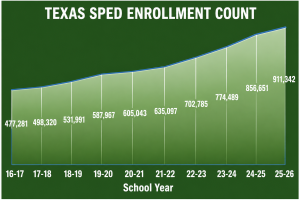
Since the end of the 8.5 percent cap, public schools responded and began identifying many more students as eligible for special education services. The total number of students enrolled in special education has risen from 477,281 in the 2016-2017 school year to 911,342 in the 2025-2026 school year. That’s almost a 91 percent increase over the past decade. Disability Rights Texas is proud that there is no longer a state policy to artificially suppress the identification of students with disabilities.